
Welcome to TeleSecurity Sciences
TeleSecurity Sciences is composed of industry pioneers in both the Homeland Security Industry and the Medical Industry. Over the past 25 years, we have formed some of the most successful Imaging Companies in both markets, and have a wide breath of knowledge and experience in these markets. Our objective is to leverage off of this experience in order to push the technology “envelope” in the Homeland Security market. We are taking the best-of-the-best in both markets, and transferring this knowledge to ensure we leverage the best of each worlds.
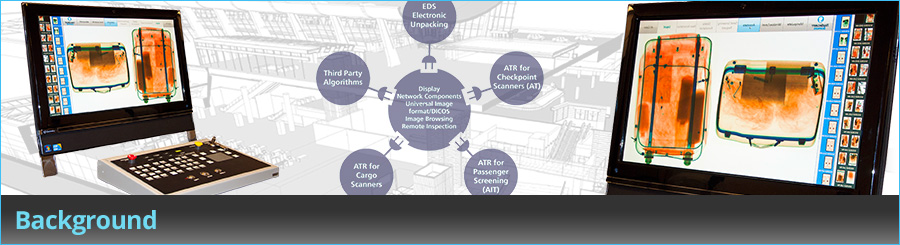
An example of this is the Common Workstation for Homeland Security. This is a workstation that has open architecture, and allows screeners to work on just one platform to screen bags, cargo, and vehicles. This is designed to work across all Imaging Security Equipment, and thus Security Personnel do not have to learn a new interface when using different security equipment. Thus it provides vendor independence and a common interface. For 3rd Party software developers, the Common Workstation provides an open platform to develop new applications. Thus they now have a path to commercialization for new innovations. The Common Workstation, when deployed, will be new, innovative, and a potential breakthrough for the Homeland Security industry. What is not widely known in the Homeland Security Industry is that a similar workstation has been available and in use in the Medical Industry for many years, and has turned out to be a very powerful tool that spurs innovation. Thus we are transferring our knowledge and experience in the medical industry to develop new innovations for the security market.
Some of our Products and the Benefits of these Products
Scanner Independent Automated Target Recognition (ATR). TSS has developed and validated through the Transportation Security Lab (TSL) the world's best performing ATR scanner independent software. False alarm rates of competitive systems, whether deployed or in-house have alarm rates that can produce high false alarm rates. The TSS ATR software has been validated to meet TSA/TSL requirements while delivering False Alarm rates at single digit % levels. Even a 1% improvement can result in significant savings. Thus potential savings from deploying this SCANNER INDEPENDENT software has the potential to reduce overall costs in the US by $100M/year, while increasing checkpoint throughput. ATR software has changed very little over the past 15 years. We have taken great strides in computing power, video graphics and new advanced Image Analysis algorithms to deliver truly outstanding performance. These algorithms are generic in that they are vendor independent, but are tailored to work with Cargo, baggage, and AIT. The benefits of using our Target software include:
- Highest accuracy in the industry
- Lowest false alarm rate in the industry - a reduction of 2X or more false alarms
- Significantly lower overall costs, due to the higher accuracy and lower false alarm rate
- Designed for checked and carry-on baggage, and cargo screening
- TLS tested and approved to meet Aviation Security Standards
The Common Workstation (CW). The Common Workstation is designed to work with all Imaging Security equipment. This Workstation is used by security screeners, supervisors, and other personnel who require access to the images and information that Imaging Security Equipment provides. The CW runs TSS software, as well as 3rd party software. The benefitsof using the Common Workstation include:
- Reduced operational and training costs due to common interface
- Allows users to use “best-in-class” software for imaging, TIP, Automated Detection, etc. because of the open architecture
- Improves security while lowering costs
3D Electronic Unpacking (EU). Conventional Computed Tomography provides a 3D image of the bag under review. With the TSS EU software, the screener can virtually unpack the bag, by removing items from the bag. This allows the screener to view an uncluttered image of questionable areas in the bag with the items unpacked, greatly aiding in the ability to effectively screen the bag. The benefits of using EU include:
- Improved alarm resolution process because items can be removed piece-by-piece
- Lowers EDS alarm rate, reducing bags going to 3rd level of screening
- Lowers overall bag screening costs, while improving performance
Liquid Detection. Terrorists have attempted multiple attacks using liquids carried in checkpoints. Current airport security does not allow for more that 3 ounces of liquid to be carried through the checkpoint. Our new liquid detection software automatically analyzes liquids that are run through the X-ray system, and provides an accurate categorization of the liquid in the container. Our system has proven to deliver superior performance than competitive systems, based a US gov’t sponsored evaluation of competitive systems. The benefits of using our Liquid Detection include:
- Accurate identification of liquids in containers
- Accurately separate threats from benign liquids
- Works on all major security checkpoint systems
- Provide higher security by allowing airport security personnel to focus more on threats, and less on detecting liquids in bags
TeleInspection. The performance of personnel checking bags varies by such things as the time of day, the activity level at the checkpoint, as well as the person doing the screening. We have developed the Teleinspection capability so that screening personnel can use additional expertise in analyzing threats. This capability allows the operators to send the images for remote analysis, and thus to use professionals with higher levels of training and expertise to evaluate the item being screened. The benefit of this:
- Lower chance that a threat is missed
- Reduces operator fatigue by sharing the load
- Improves checkpoint security
